
One of the economic impacts of Covid-19 is the acceleration of existing trends and changes in the real estate sector. As a crisis-proof investment option, residential property remains a safe choice in terms of risk and return. Swiss Life Asset Managers remains very active throughout Europe as a pioneer in this area.
The residential sector has been particularly resilient on the European stock exchanges since the onset of the
coronavirus crisis: the EPRA residential property index, which also includes European real investment trusts, suffered fewer losses than other sectors. The listed residential property market has now returned to pre-crisis levels in Europe as well as in the US and Asia.
Globally, the residential sector has even overtaken other asset classes. Other areas such as office and retail are not yet over the crisis. Residential property is therefore currently the strongest asset class in this area. Its advantages include outperformance in times of recession and its diversity. It is also less dependent on equities and commercial real estate.
Return reliably compensates for risk
The residential sector's total return has been 7.8% annually over the past ten years and as much as 10.4% annually over the past five years, measured by the European MSCI Index including unlisted vehicles. Compared with other real estate investments, the total return only fluctuates slightly and is well above the value of 1.0 throughout Europe on a risk-adjusted basis. This shows that the return reliably compensates the risk. This is particularly true in large European cities, where demand for rental apartments outstrips supply.
In particular, steady rental growth in those European cities that offer the most work have driven cash flow returns over the past ten years:
- 2.6% p.a. e.g. in London, Paris, Lyon
- 3.1% p.a. e.g. in Berlin, Düsseldorf, Frankfurt, Hamburg, Munich·
- 3.5% p.a. e.g. in major Dutch cities·
- 3.0% p.a. in Geneva
- 3.4% p.a. in Zurich
On top of this, yields are also driven by steady capital appreciation – with the exception of London, where real estate values have been falling since Brexit.
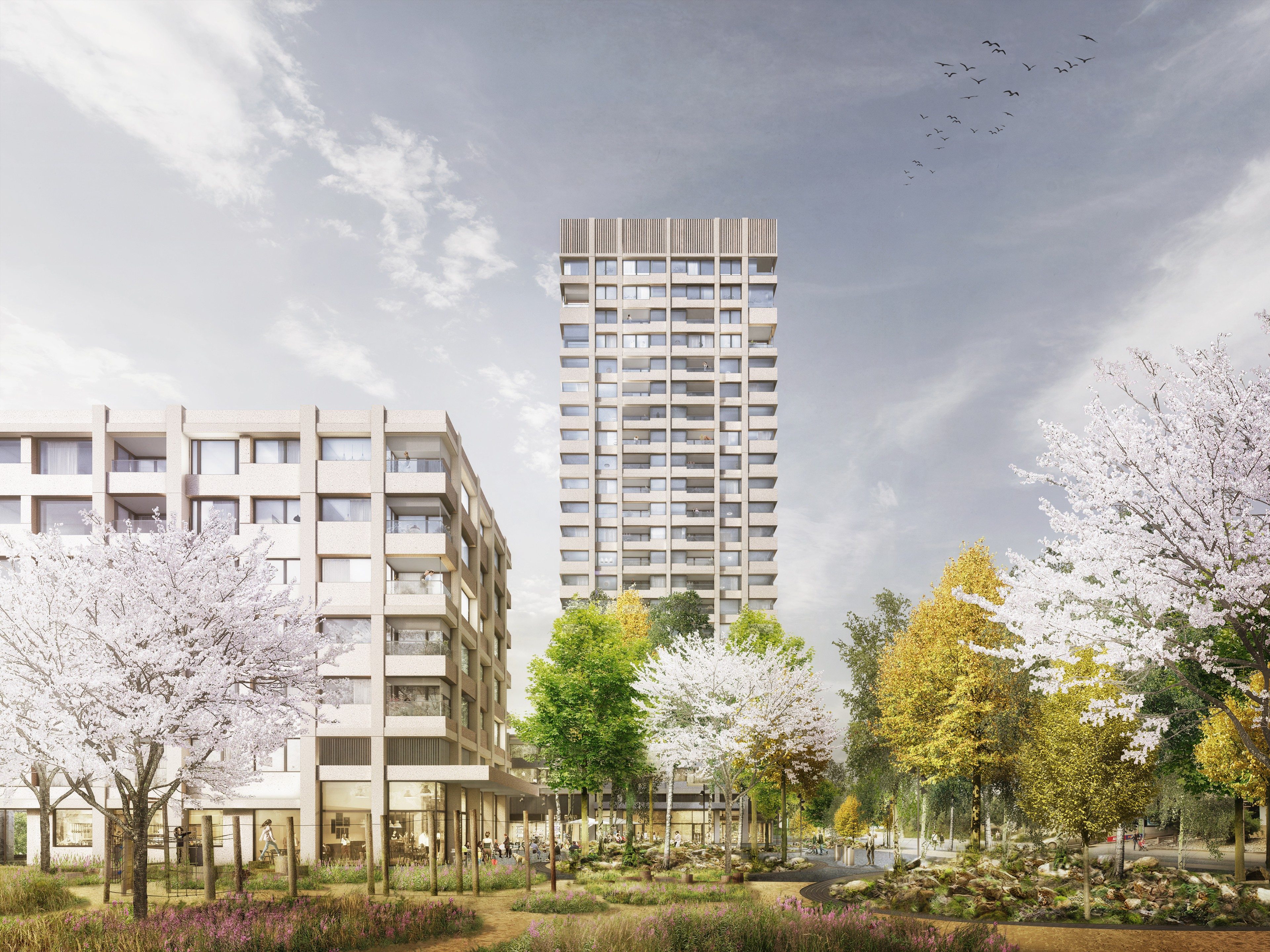
New standards in urban development: the newly constructed high-rise apartment building in Zurich Altstetten. Source: Gali Rudolf
Number of residential property shares and funds on the rise
For pension insurers and pension funds, private rented accommodation and affordable housing are of particular interest because of their secure returns and stable earnings. Both areas are equally affected by demographic and urbanisation trends, most notably the increasing demand for rental apartments and affordable housing in major cities. They complement each other well. In addition, both areas are important in terms of economic competitiveness and for social balance in the post-Covid-19 period.
The number of residential property shares and funds has been increasing since 2018. We expect this trend to continue as the asset class is not correlated to economic growth. Real estate also offers opportunities to do something good for nature and society: firstly, urbanisation is reducing the CO2 footprint. Secondly, the real estate sector can channel responsible and institutional investments towards social housing and affordable living space. This helps reduce the friction between a dynamic job market and sustainable living costs, thereby enabling a self-determined life in large cities.
As an investor with a strong presence throughout Europe, Swiss Life Asset Managers benefits from legal expertise in individual countries and the economies of scale reflecting its size. This provides a clear competitive advantage in the area of private and affordable rental apartments.
Author: Beatrice Guedj, Head of Research & Innovation, Swiss Life Asset Managers, France
Source: First published in "Insights October 2020".