


Higher interest rates, geopolitical uncertainty and increasingly concentrated equity markets are changing the rules of the game for investors. In this environment in particular, a multi-asset approach is becoming increasingly relevant, as it can help capture opportunities wherever they arise while providing better risk management.
Capital markets have changed. While in recent years a clear focus on equities was often sufficient, the investment landscape has become considerably more complex. Interest rates are back, geopolitical uncertainties persist, and many markets are being driven by a handful of dominant themes such as
artificial intelligence (AI). At the same time, valuations have risen across various market segments, and investor expectations are correspondingly high.
Against this backdrop, a multi-asset approach is gaining importance. Not because it seeks to predict the next market move, but because it combines different sources of return and thus creates greater flexibility. Today, investors no longer need to rely exclusively on equities to access attractive income opportunities. With the return of higher interest rates, bonds are once again making a meaningful contribution to overall portfolio income. When complemented by real assets or alternative strategies, additional diversification opportunities emerge.
Diversification that delivers more
Diversification is one of the most frequently used concepts in the financial industry. The key question, however, is whether it continues to work when market conditions become more challenging.
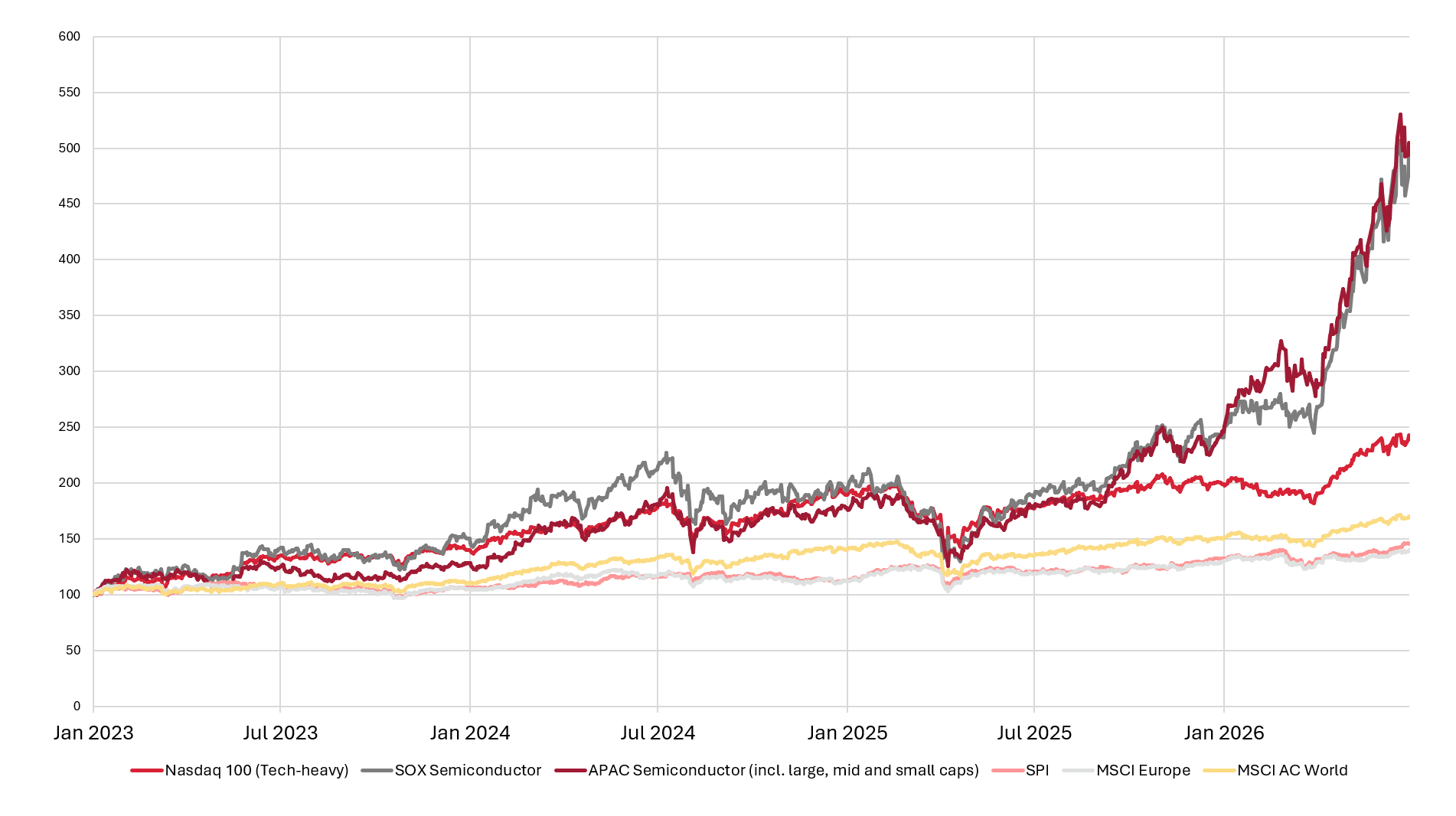
Recent market developments provide a clear illustration. A large share of equity market returns has been driven by a small number of technology and AI stocks.
Growing sector dispersion in equity markets highlights the importance of selectivity
Source: Swiss Life Asset Managers (as at: 30.06.2026)
Behind the positive index performance, however, lies a widening gap between winners and losers. While
the overall market appears stable, differences beneath the surface are becoming increasingly pronounced.
As a result, selectivity is becoming more important than simple market exposure. Today, opportunities are created less by merely being invested and more by the targeted selection of regions, sectors and sources of risk. A flexible multi-asset approach can capitalise on these differences while reducing dependence on individual market segments.
Managing rather than chasing
Recent months have shown that strong market phases often go hand in hand with rising expectations.
The higher valuations climb and the greater the market optimism, the narrower the margin for error
tends to become. Many positive developments now appear to be reflected in market prices. As a result,
the balance between opportunities and risks is once again becoming a key factor to consider.
This is precisely why discipline matters more today than the pursuit of short-term trends. Successful investing is not about chasing yesterday’s winners. It is about continuously reassessing opportunities
and risks and allocating capital where the potential remains attractive.
A modern multi-asset approach embodies precisely this mindset. It combines different asset classes, emphasises selectivity rather than simply following the market, and adapts to changing market conditions.
In an increasingly complex world, this flexibility can prove a decisive advantage for long-term investors.
Swiss Life Asset Managers is an experienced asset manager with expertise in the management of institutional investments taking ESG criteria into account.